




Boston’s housing market has changed over the past few years, but one question continues to dominate conversations: Is it still a seller’s market?
If you’ve been following the real estate market over the past several years, you’ve likely seen headlines about rising home prices, higher mortgage rates, bidding wars, and limited inventory. While the market has undoubtedly evolved since the unprecedented buying frenzy of 2021 and 2022, Boston remains one of the strongest real estate markets in the country. Buyers today have more opportunities than they did just a few years ago, but sellers continue to benefit from historically low inventory and steady demand.
Whether you’re thinking about buying your first home, upgrading to more space, downsizing, or preparing to sell, understanding current market conditions can help you make more confident decisions. In this guide, we’ll explore what defines a seller’s market, examine the latest Boston housing data, highlight neighborhood trends, and explain what both buyers and sellers should expect throughout 2026.
What Is a Seller’s Market?
Before deciding whether Boston is still a seller’s market, it’s helpful to understand what the phrase actually means.
A seller’s market occurs when there are more active buyers than available homes for sale. With fewer listings to choose from, buyers often compete against one another, giving sellers greater negotiating power. This environment typically leads to shorter marketing times, stronger offers, and sale prices that meet or exceed asking price.
One of the most common ways economists measure market conditions is by looking at months of housing inventory. A balanced housing market generally has between five and six months of inventory, meaning it would take that long for all current homes on the market to sell if no new listings became available.
Anything below three months is typically considered a seller’s market.
Boston has remained well below that threshold for several years.
While the pace of appreciation has moderated compared to the peak pandemic years, inventory remains constrained enough that sellers continue to hold an advantage in many neighborhoods.
Common Characteristics of a Seller’s Market
- Low housing inventory
- Strong buyer demand
- Homes selling quickly
- Multiple-offer situations
- Sale prices at or above asking price
- Limited room for buyer negotiation
Unlike rapidly growing Sun Belt markets that have experienced dramatic shifts in inventory, Boston’s market is supported by long-term fundamentals including limited land for development, a strong employment base, world-renowned universities, and a highly educated workforce. These factors help explain why Boston has historically remained resilient through changing economic cycles.
Boston Housing Market Snapshot
Although headlines often focus on mortgage rates, inventory remains the story that continues to shape Boston’s housing market.
As of May 2026, Boston continues to experience limited housing supply compared to historical averages. Well-maintained homes in desirable neighborhoods frequently receive multiple offers within the first two weeks on the market, particularly when priced appropriately.
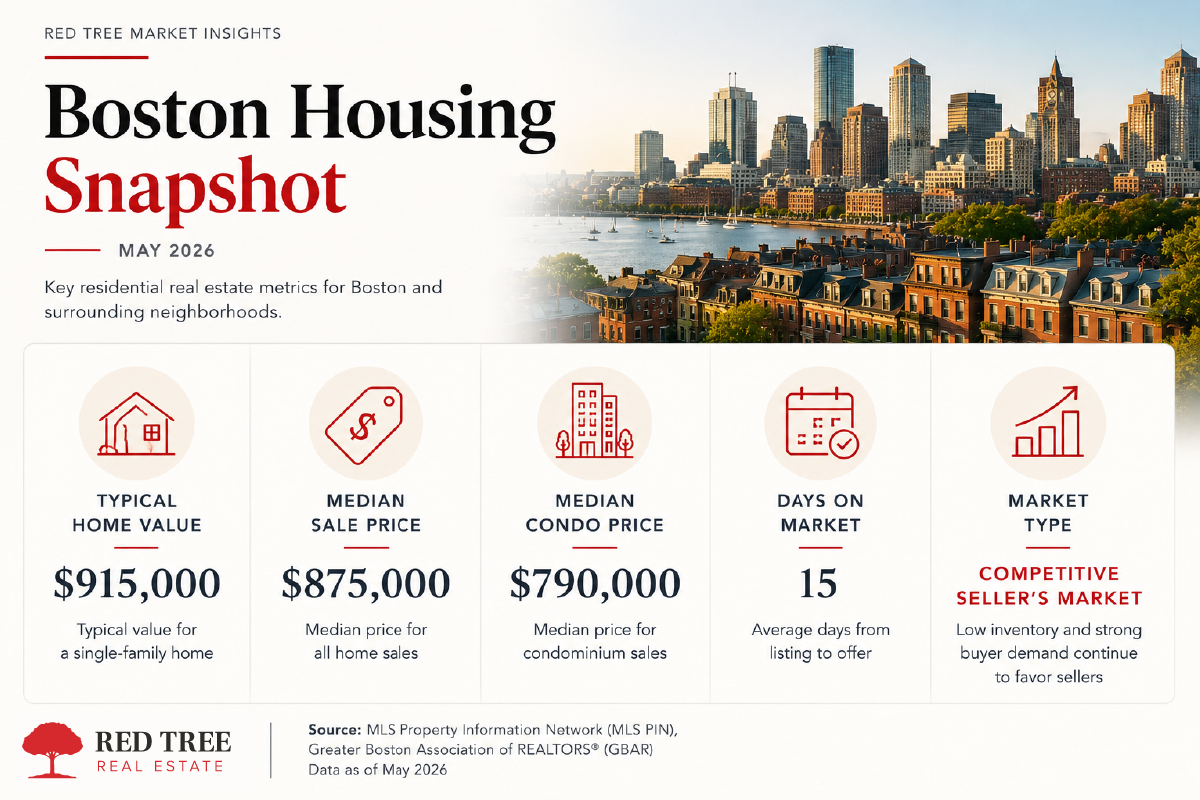
While these numbers vary by neighborhood, they illustrate an important point: buyers remain active despite higher borrowing costs. Demand has softened compared to previous years, but inventory has remained even tighter, helping support home values throughout Greater Boston.
Another statistic worth watching is the sale-to-list price ratio. In many Boston neighborhoods, homes continue to sell for approximately 100% to 102% of their asking price, indicating that well-priced properties remain highly competitive.
This doesn’t necessarily mean every home sells above asking. Rather, it reflects a market where desirable homes continue to attract serious buyers, while overpriced listings tend to sit longer until expectations align with market conditions.
Why Boston Still Favors Sellers
Every housing market has unique drivers, and Boston’s are particularly difficult to replicate elsewhere.
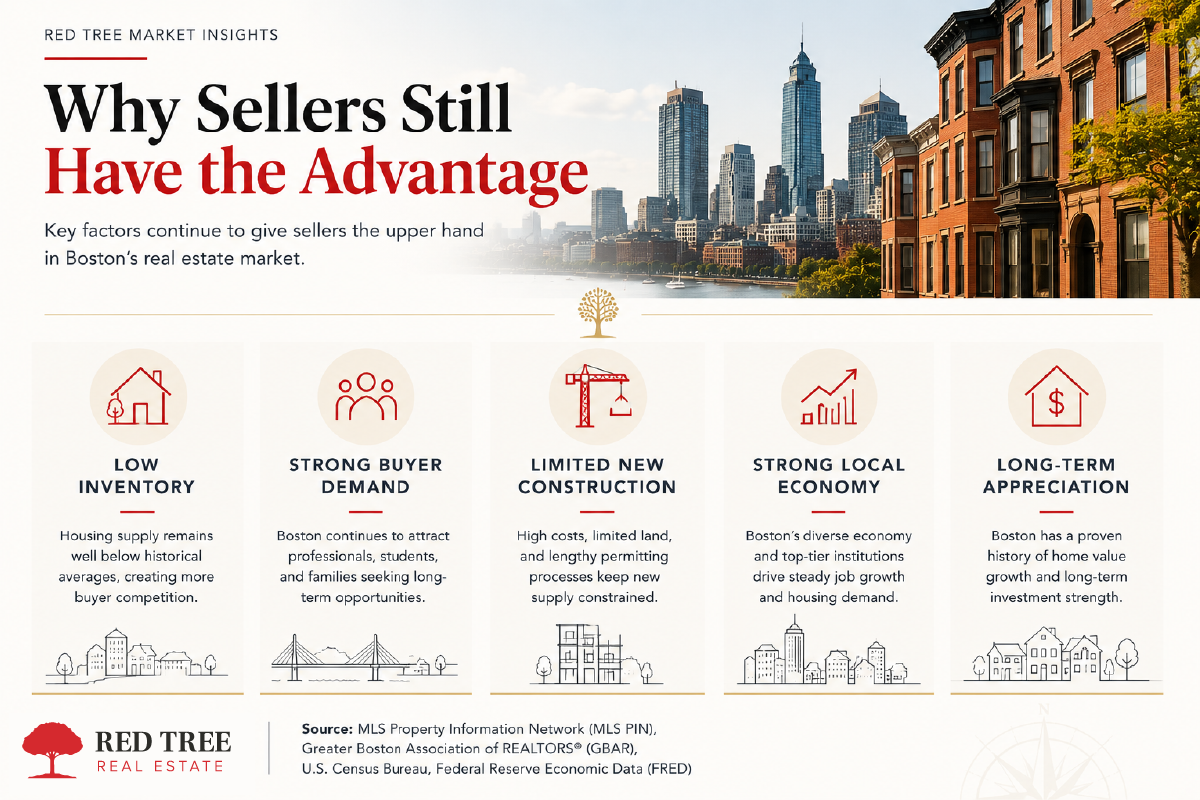
Unlike many metropolitan areas that can continue expanding outward, Boston faces significant geographic limitations. Water, established neighborhoods, protected open space, and dense urban development all limit opportunities for large-scale residential construction. As a result, new housing inventory enters the market more slowly than buyer demand grows.
At the same time, Boston continues to attract professionals from around the world.
Healthcare, biotechnology, finance, higher education, and technology remain major pillars of the local economy. Institutions like Mass General, Brigham and Women’s Hospital, Harvard University, MIT, Boston University, and Northeastern University create a steady pipeline of residents looking to live close to work.
That combination of limited supply and consistent demand continues to support home values across much of Greater Boston.
One trend we’ve observed at Red Tree Real Estate is that buyers today are often more strategic than they were several years ago. They’re taking more time to evaluate financing, monthly payments, and neighborhood fit before making offers.
That doesn’t necessarily weaken the seller’s position.
Instead, it means that presentation, pricing, and marketing have become increasingly important. Homes that are professionally prepared continue to perform exceptionally well, while properties that are overpriced or poorly marketed tend to remain available longer than they would have during the height of the pandemic market.
Signs the Market Is Beginning to Normalize
Although Boston remains a seller’s market, that doesn’t mean conditions are exactly the same as they were a few years ago.
During the height of the pandemic housing boom, buyers often waived inspections, offered well above asking price, and made decisions within hours of a listing going live. Today’s market is noticeably more balanced. Buyers have become more selective, mortgage rates have affected affordability, and sellers can no longer assume every home will generate ten competing offers.
That’s healthy.
A balanced market doesn’t necessarily mean falling prices. Instead, it often creates more
sustainable transactions where buyers have time to evaluate homes carefully and sellers who prepare their properties properly are rewarded.
Some signs of normalization include:
Slightly longer average days on market than during 2021–2022
More price adjustments on overpriced listings
Increased importance of home condition
Greater emphasis on staging and professional marketing
Buyers requesting inspections more frequently
At Red Tree, we’ve seen that homes priced correctly continue to move quickly, while homes that “test the market” with unrealistic pricing often require reductions before attracting serious interest.
This shift highlights an important distinction: it’s still a seller’s market, but strategy matters more than ever.
What Buyers Need to Know
For buyers, today’s market presents opportunities that simply didn’t exist a few years ago.
Competition remains strong, but many buyers no longer feel pressured to make rushed decisions after only one showing. That breathing room allows for better financial planning and more thoughtful home comparisons.
Preparation, however, is still essential.
Before beginning your search, you should:
Obtain a mortgage pre-approval.
Understand your monthly payment range.
Research neighborhood market trends.
Be ready to act quickly on well-priced homes.
Work with an agent who understands local inventory.
💡 Red Tree Buyer’s Tip
Don’t focus exclusively on interest rates. Many buyers wait for rates to fall, assuming lower rates automatically mean lower monthly costs. In reality, lower mortgage rates often increase buyer competition, which can drive home prices even higher. Buying the right home when you’re financially prepared often matters more than trying to perfectly time the market. Another factor buyers should consider is neighborhood variation.
While South Boston or Back Bay may remain extremely competitive, neighborhoods like Roslindale, Hyde Park, or portions of Brighton can sometimes offer more opportunities depending on inventory and pricing. The “Boston market” isn’t one market. It’s dozens of neighborhood markets operating simultaneously.
What Sellers Should Expect
If you’re preparing to sell your home, the good news is that market conditions remain favorable. However, success today depends less on simply listing your property and more on how it’s presented to buyers.
Professional photography, thoughtful staging, accurate pricing, compelling marketing, and strategic exposure all play a much larger role than they did during the peak seller frenzy. Today’s buyers are comparing every listing online before scheduling a showing.
They notice:
- Professional photography
- Floor plans
- Virtual tours
- Home condition
- Recent updates
- Energy efficiency
- Outdoor space
💡 Red Tree Seller’s Tip
The first week your home is on the market is often the most important. Properties that generate significant interest immediately typically receive stronger offers than homes that linger on the market for several weeks. Pricing correctly from day one is almost always more effective than pricing high and reducing later.

Which Boston Neighborhoods Are Hottest Right Now?
Boston isn’t one housing market.
Each neighborhood experiences different inventory levels, buyer demand, price appreciation, and competition.
Here are several neighborhoods that continue attracting strong buyer interest.
Brighton
Brighton remains one of Boston’s most accessible entry points for first-time buyers and investors.
Green Line access, proximity to universities, and a healthy mix of condominiums and multifamily properties continue driving demand.
Jamaica Plain
Known for its walkability, historic homes, restaurants, and green space, Jamaica Plain consistently attracts buyers looking for character and community.
Inventory remains competitive, particularly for renovated condominiums.
East Boston
East Boston continues to evolve through waterfront development and new construction.
Easy Blue Line access, Logan Airport proximity, and downtown connectivity have made it one of Boston’s fastest-growing neighborhoods.
Roslindale
Roslindale offers buyers an opportunity to find larger homes while remaining connected to downtown via commuter rail and major roadways.
Families often appreciate the neighborhood’s residential feel and community atmosphere.
South Boston
South Boston remains one of Boston’s strongest markets thanks to its proximity to downtown, the Seaport, and waterfront amenities.
Inventory remains competitive across many price points.
How Interest Rates Continue to Shape the Market
Mortgage rates continue to influence housing affordability, but they haven’t dramatically reduced Boston’s demand.
Instead, they’ve created a unique situation.
Many existing homeowners currently hold mortgage rates below 4%.
Selling today often means purchasing another home with a significantly higher interest rate, leading many homeowners to delay moving.
Economists refer to this as the “lock-in effect.”
Ironically, higher rates have helped reduce inventory because fewer homeowners are listing their properties.
That reduced supply has helped support home prices despite slower buyer activity.
📈 Market Trend to Watch
As mortgage rates gradually stabilize, many analysts expect more homeowners to re-enter the market, increasing inventory over time.
While this could create additional opportunities for buyers, Boston’s long-term housing shortage means dramatic price corrections remain unlikely unless inventory increases substantially.
Should You Buy or Sell in Today’s Market?
Trying to perfectly predict the housing market has always been difficult.
Instead of asking whether today is the perfect time, successful buyers and sellers usually ask a different question:
Does moving today help me reach my long-term goals?
If your family needs more space, your commute has changed, or you’re ready to become a homeowner, waiting for perfect market conditions may not be the most effective strategy.
Likewise, sellers continue to benefit from historically strong home values, especially when their home is thoughtfully prepared and professionally marketed.
Real estate remains a long-term investment.
Making decisions based on your personal circumstances rather than short-term headlines often produces the best results.
Data Sources
The market information referenced throughout this article is compiled from publicly available housing and economic data, including:
- MLS Property Information Network (MLS PIN) – Residential sales activity, median sale prices, inventory, and days on market.
- Greater Boston Association of REALTORS® (GBAR) – Monthly Boston housing market reports.
- Massachusetts Association of REALTORS® (MAR) – Statewide housing statistics and inventory trends.
- Federal Reserve Economic Data (FRED) – Mortgage rate trends and economic indicators.
- U.S. Census Bureau – Population and demographic information.
- Red Tree Real Estate Market Research – Local neighborhood analysis and Greater Boston market insights.
Statistics referenced in this article reflect the most recent data available at the time of publication (May 2026). Real estate markets change frequently and individual neighborhoods may perform differently than citywide averages.
Disclaimer
The information provided in this article is intended for educational purposes only and reflects the most current market data available at the time of publication. Real estate markets change frequently, and individual neighborhoods may experience different trends. For the most up-to-date market information and personalized guidance, contact a Red Tree Real Estate professional.
Conclusion
Boston’s housing market continues to favor sellers, but today’s market is more strategic than it is frenzied. Buyers have more time to evaluate opportunities, while sellers who prepare and price their homes correctly continue to achieve strong results.
Whether you’re planning to buy your first home, move into a larger property, or sell your current one, understanding today’s market conditions can help you make informed decisions with confidence.
Thinking about buying or selling in Greater Boston? The team at Red Tree Real Estate combines local expertise with data-driven market insights to help you navigate every step of the process. Contact us today to schedule a complimentary consultation.

Additional Articles & Posts

The 2026 Boston First-Time Homebuyer Guide: Programs, Down Payments & What You Actually Need to Save

Boston first-time homebuyer guide for 2026: learn down payment options, assistance programs, closing costs, and how much cash you need to buy.

Buying a home in Greater Boston? Learn how to buy the right neighborhood by evaluating commute, lifestyle, amenities, and long-term value before making an offer.


Preparing to sell your home in Boston? Learn the expert tips that can help your home stand out, attract more buyers, and maximize your sale price in today's competitive market.
See what your home is worth
Enter your home address to receive a free market analysis and
home valuation from us.
Need help? Call our office at 617.944.5311