



Rent control is back in the Boston housing conversation, but the latest developments are more complicated than a simple yes-or-no debate.
Boston renters are facing one of the most expensive housing markets in the country, and frustration around affordability has pushed rent control and rent stabilization back into the spotlight. A proposed 2026 statewide ballot question that could have brought rent control back to Massachusetts was recently blocked from appearing on the ballot, leaving many tenant advocates disappointed and many property owners watching closely. At the same time, city leaders, housing advocates, developers, and state lawmakers continue debating whether a more limited local-option rent stabilization policy could move forward. In this article, we’ll break down what happened, what rent control actually means, why Boston is having this conversation now, and what renters, landlords, buyers, and investors should understand.
Why Rent Control Is Back in the Conversation
Rent control is not a new issue in Massachusetts.
The state previously allowed rent control in certain communities, including Boston, Cambridge, and Brookline, before voters eliminated it through a statewide ballot question in 1994. Since then, Massachusetts has had a statewide ban on traditional rent control, meaning cities and towns cannot create their own rent control programs unless state law changes or the Legislature grants permission. The issue has returned because housing costs have continued to rise faster than many renters’ incomes.
For many Boston households, the question is no longer simply whether rent is expensive. It is whether long-term renters can realistically remain in their neighborhoods.
What Happened With the 2026 Ballot Question
A proposed 2026 statewide ballot question sought to bring rent control back to Massachusetts. The proposal would have limited annual rent increases to inflation or 5%, whichever was lower, making it one of the strictest rent cap proposals in the country.
However, the Massachusetts Supreme Judicial Court blocked the question from appearing on the November ballot. The court ruled that the petition improperly included an exemption involving religious facilities, which made the proposal relate to religion, an excluded subject under the Massachusetts ballot initiative process.
For tenant advocates, the ruling was deeply frustrating because it removed a major pathway for voters to weigh in directly.
For opponents, including many real estate groups, the ruling reduced the immediate risk of a statewide rent cap taking effect.
What Rent Control Actually Means
“Rent control” is often used as a broad term, but there are different versions. Traditional rent control usually refers to strict limits on how much landlords can charge or increase rent.
Rent stabilization is often more flexible. It typically allows annual rent increases but caps them according to a formula, such as inflation plus a set percentage.
In Boston’s recent conversations, most local proposals have focused on rent stabilization rather than a full rent freeze. That distinction matters.
Rent stabilization aims to protect tenants from sudden rent spikes while still allowing property owners to increase rents over time.
How Boston’s Rent Stabilization Proposal Works
Mayor Michelle Wu previously supported a local rent stabilization proposal that would cap annual rent increases at the Consumer Price Index plus 6%, with a maximum increase of 10%.
The proposal also included just-cause eviction protections. Importantly, it included exemptions for certain properties, including newer construction and smaller owner-occupied buildings.
That structure was designed to balance tenant protections with concerns about housing production and small property owners. Since Massachusetts currently bans rent control, Boston cannot enact this type of policy on its own. The city would need approval from the state Legislature.
Why Tenants Are Pushing for Stronger Protections
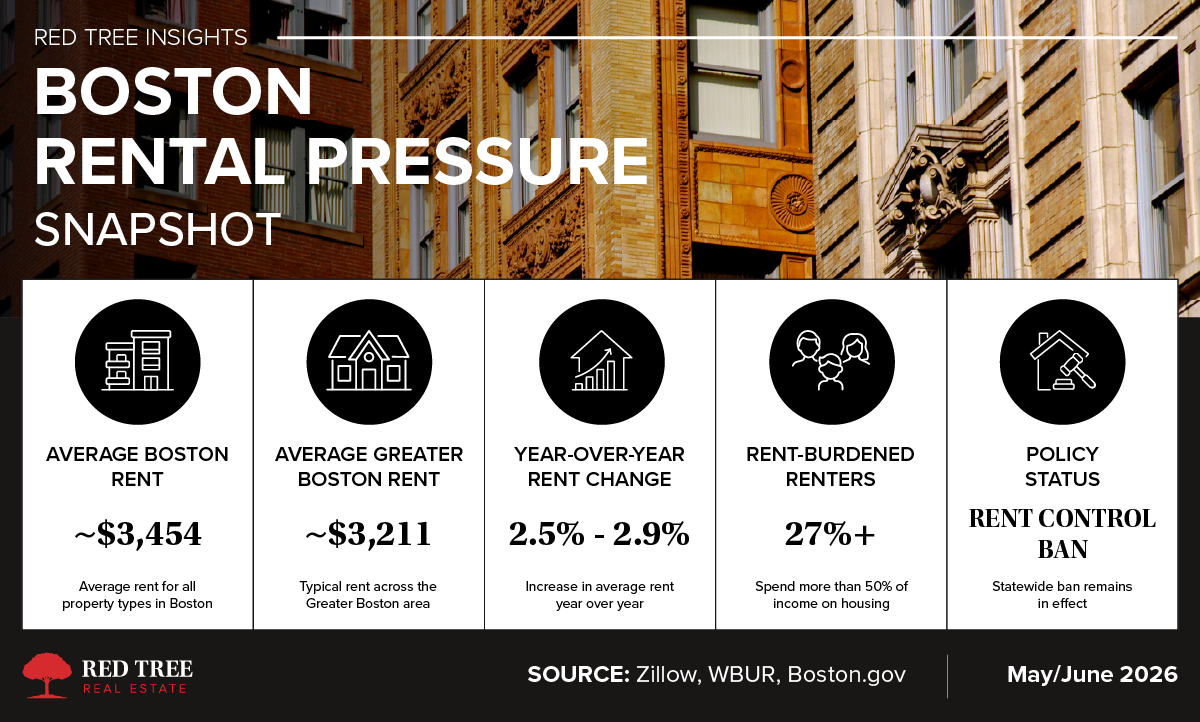
For tenants, the push for rent stabilization is rooted in housing stability. Boston remains one of the most expensive rental markets in the country. Zillow reported Boston’s average rent at approximately $3,454 as of May 2026, while the broader Boston area’s typical rent was reported around $3,211.
That level of rent requires a significant household income to remain affordable. Housing advocates often point to cost burden as the core issue. A household is generally considered cost-burdened when it spends more than 30% of income on housing.
Boston officials have cited that more than 27% of renters are severely burdened, meaning they spend more than 50% of income on housing. For these renters, a sudden rent increase can mean leaving a neighborhood, changing schools, moving farther from work, or facing housing insecurity.
Why Property Owners and Developers Are Concerned
Opponents of rent control argue that strict rent caps can create unintended consequences. Their concerns usually fall into a few categories.
First, property owners worry that limits on rent increases may make it harder to keep up with rising insurance, taxes, maintenance, utilities, and repair costs.
Second, developers argue that rent control can make new housing projects less financially viable, especially in a market where construction costs are already high.
Third, some housing economists argue that limiting rents without increasing supply can discourage investment and reduce the number of available rental units over time.
This is why many property owners distinguish between helping tenants directly and regulating rents broadly. The policy debate is not simply “pro-tenant” versus “pro-landlord.” It is really about how Boston can create stability without worsening the housing shortage.
What the Data Says About Boston Rents
Boston’s rental market remains expensive, even though rent growth has moderated from the sharp increases seen earlier in the decade.
Zillow’s May 2026 data showed Boston average rent at approximately $3,454, up 2.9% year over year.
WBUR reported the typical rent in the Boston area at $3,211 in May 2026, up 2.5% year over year.
BostonPads reported the citywide average rent around $3,408 in its 2026 rental market report, up about 2.62% year over year.
In plain language: rents are not rising as aggressively as they did during the post-pandemic surge, but they are still extremely high. That is why rent control conversations have not gone away. Even slower rent growth can feel unsustainable when the starting point is already out of reach for many households.
How This Could Affect Boston’s Rental Market
If rent stabilization were eventually approved in some form, it could affect the Boston rental market in several ways.
For tenants, it could create more predictability around annual rent increases.
For landlords, it could require more careful long-term planning around expenses, lease renewals, and property improvements.
For investors, it could change how multifamily properties are valued, especially if future rent growth is capped.
For developers, the biggest question would be whether new construction remains exempt and for how long.
A policy that exempts new buildings may have a different market impact than one that applies broadly across all rental housing. This is why the details matter so much. A 5% statewide cap, a CPI-plus-6% Boston cap, and a local-option compromise would all create very different outcomes.

What Renters and Landlords Should Watch Next
The ballot question may be off the table for 2026, but the rent control conversation is not over. Renters should watch whether tenant groups return with a revised proposal, push for legislation on Beacon Hill, or focus on local-option rent stabilization. Landlords and investors should watch whether lawmakers revisit a compromise proposal that would allow cities and towns to opt into rent stabilization.
Boston property owners should also continue monitoring operating costs, insurance premiums, tax changes, and local housing policy. For renters, the most practical next step is to understand lease renewal timelines, know tenant rights, and communicate early if a proposed rent increase creates hardship. For landlords, the most practical next step is to stay informed, document expenses, and price renewals carefully in a market where affordability is under intense public scrutiny.
Data Sources
Market and policy information referenced in this article was compiled from:
* Massachusetts Supreme Judicial Court reporting on the 2026 rent control ballot question
* WBUR coverage of the rent control ballot question and compromise proposal
* Boston.gov rent stabilization resources and City Council updates
* Zillow rental market data for Boston
* BostonPads 2026 Boston Apartment Rental Market Report
* Associated Press coverage of Boston’s rent stabilization proposal
* Red Tree Real Estate market research and local rental market observations
Statistics reflect the most recently available data at the time of publication and may change as new market reports are released.
Conclusion
Rent control conversations in Boston are not going away because the affordability problem has not gone away. The 2026 ballot question may have been blocked, but tenant advocates, city officials, landlords, developers, and lawmakers are still debating what comes next.
Have questions about Boston’s rental market? Red Tree Real Estate works with renters, landlords, investors, and property owners across Greater Boston. Contact our team to better understand today’s market and your options.

Additional Articles & Posts
The 2026 Boston First-Time Homebuyer Guide: Programs, Down Payments & What You Actually Need to Save

Boston first-time homebuyer guide for 2026: learn down payment options, assistance programs, closing costs, and how much cash you need to buy.


Buying a home in Greater Boston? Learn how to buy the right neighborhood by evaluating commute, lifestyle, amenities, and long-term value before making an offer.

Preparing to sell your home in Boston? Learn the expert tips that can help your home stand out, attract more buyers, and maximize your sale price in today's competitive market.
See what your home is worth
Enter your home address to receive a free market analysis and
home valuation from us.
Need help? Call our office at 617.944.5311